


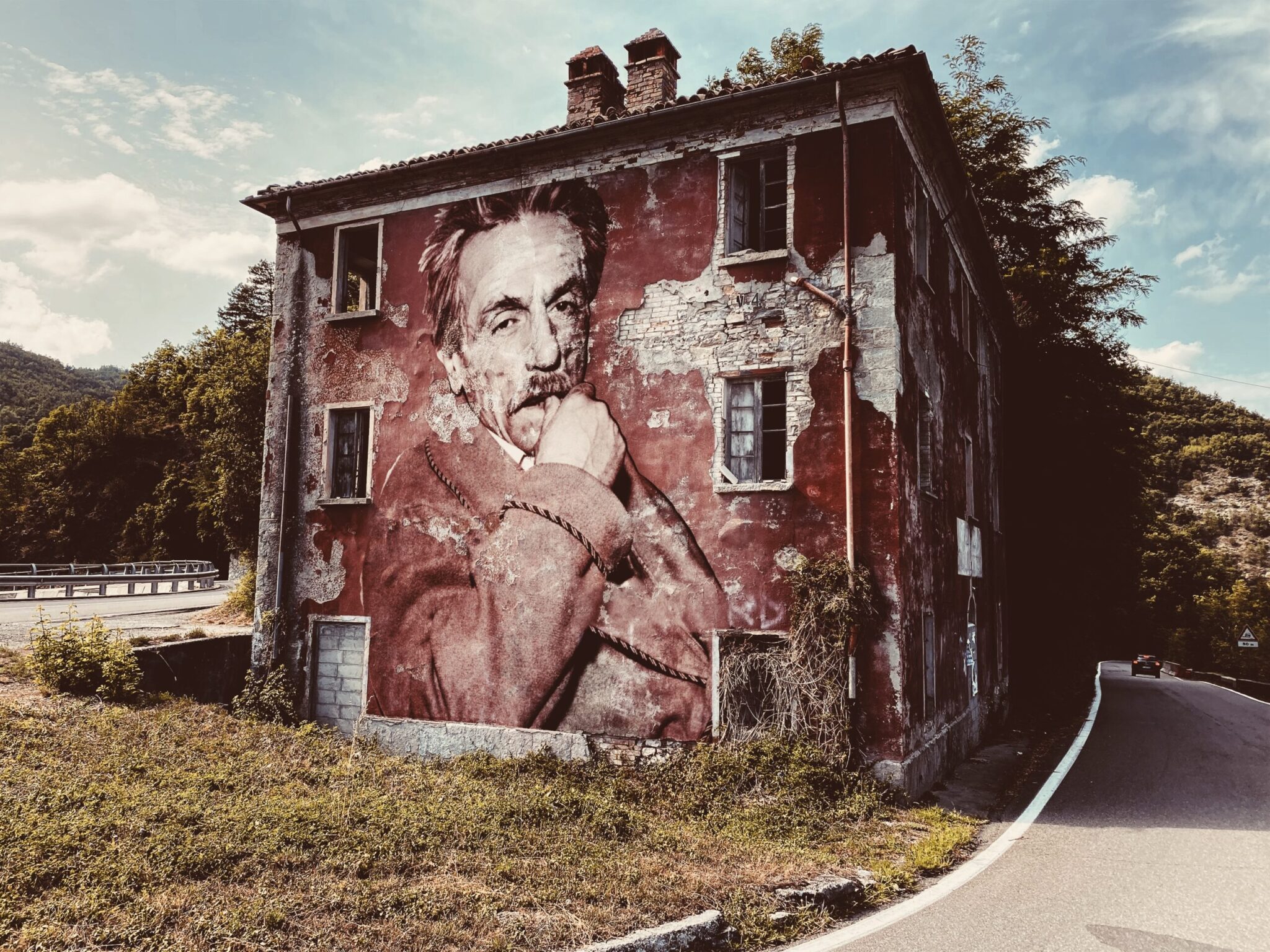
Your recent body of work marks a clear shift toward historical figures and abandoned locations. What led you to concentrate so strongly on memory and the passage of time?
Time has always been present in my work, but now it has become explicit.
I reached a point where reacting to the present felt insufficient. The present changes too quickly and often without consequence. Memory, instead, accumulates. Working with abandoned walls allowed me to deal with time in a physical way, not as an abstract concept but as something visible, cracked, and deteriorated.
The title of your latest series, “…and we hired a bloke to fix the wall”, carries an ironic undertone. How does it relate to the core idea of the project?
The title plays with contradiction.
On one side there is the idea of fixing, repairing, covering damage. On the other there is the awareness that some fractures should not be erased. The series is about exposing what time has done rather than hiding it. The wall doesn’t need to be fixed—it needs to be read. The irony lies in our constant desire to smooth things over instead of understanding them.
Many of the figures portrayed in the series are intellectuals, writers, and artists. Why was it important for you to bring these particular voices back into public space?
Because their ideas were never meant to remain silent.
These figures shaped ways of thinking that are still relevant today, even when they are uncomfortable or inconvenient. Bringing them into public space is a way of restoring friction. They interrupt the visual routine of the street and remind us that thought has weight, even when the body is long gone.
Your installation process is unusually precise for street art. Could you describe how technique becomes part of the conceptual framework?
In this project, technique is not neutral—it’s essential.
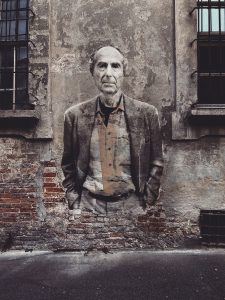
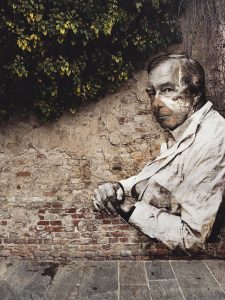
I start by photographing the wall in detail. That image becomes a skin that I digitally imprint onto the portrait. When the paste-up returns to the same wall, the textures align perfectly. This precision creates the illusion that the figure is emerging from within the surface, not imposed onto it. Without that process, the work would lose its sense of presence.
There is a strong sense that these figures are neither fully present nor entirely absent. How important is this ambiguity?
It’s fundamental.
I’m not interested in monuments. Monuments are static and reassuring. These figures exist in a fragile state, halfway between visibility and disappearance. That ambiguity mirrors our relationship with history: we know it’s there, but we often choose not to look at it closely.
Why do abandoned historical centers play such a central role in “…and we hired a bloke to fix the wall”?
Because abandonment removes mediation.
These places are not curated; they don’t explain themselves. They carry the marks of time without justification. By working in these environments, the artwork becomes part of an existing narrative rather than an intrusion. The wall is not a backdrop—it’s a collaborator.
Your work often challenges the boundary between art and public space. How does this series reflect your idea of the street as an open-air gallery?
The street is the only space where art cannot fully control its audience.
Anyone can encounter the work unexpectedly, without preparation or context. “…and we hired a bloke to fix the wall” embraces that uncertainty. The works are exposed, temporary, and vulnerable. That vulnerability is what makes them democratic.
What kind of reaction do you hope to provoke in someone who encounters one of these works by chance?
I don’t expect understanding. I hope for hesitation.
If someone stops, even briefly, and senses that something doesn’t belong to the present moment, then the work has succeeded. These figures are not there to explain the past but to remind us that it hasn’t gone anywhere.
BEAST BIO:
Since 2009 Beast has produced over 200 urban installations in more than 40 cities across Europe, the United States and Japan. His work and the themes he addresses have changed over the years. At the beginning he focused his attention on political and social themes and characters, creating mash-ups framed in gold and freely placed on the street, with a strong satirical connotation. Since then he moved to larger size artworks, pasting up giant posters on the walls of the main European cities, replacing advertising posters with his own artworks and creating giant murals on abandoned buildings’ facades in the countryside.
In recent years he has been developing an ongoing series where he portrays historical figures on the walls of uninhabited centers. This new series of paste ups continues the experiment of merging the ruined walls of historical centers with the subjects represented. The selected wall is first photographed, then placed in overlay on the subject and subsequently printed and glued on the wall in order to obtain a perfect match between the two surfaces. The declared intent is to make the historical characters shine through the wall, as if they continued to be present, to remind us of the importance of their reflection on the human soul.
https://www.beaststreetart.com/
