


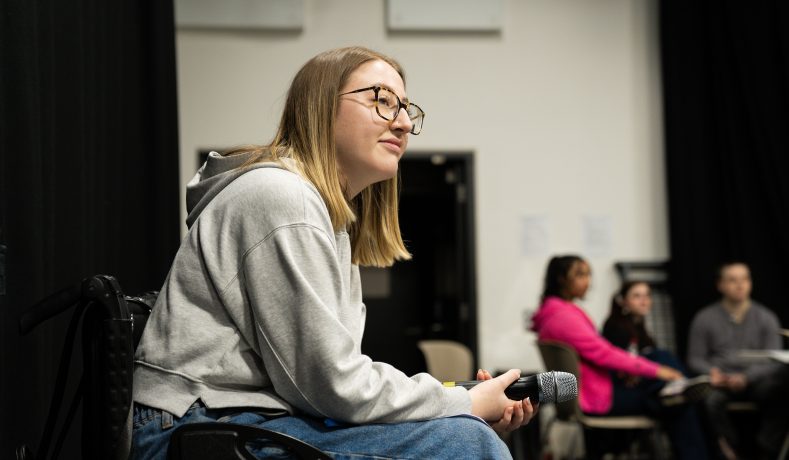
20 Stories High, Graeae Theatre Company, Liverpool Everyman & Playhouse, LEEDS 2023, Young Disabled Artists and Community Activists have launched The Access Manifesto – an urgent and pioneering call to action, encouraging arts organisations and cultural institutions to be more accessible to Deaf, Disabled and Neurodivergent young people throughout the UK.
Advocating for ‘A New Chapter for the Arts’ [fanfare emoji], The Access Manifesto is a practical, step-by-step guide – aimed at helping arts organisations, venues and individuals to take significant strides towards making the arts more accessible for all.
Theatre companies 20 Stories High from Liverpool and London-based Graeae Theatre Company first joined forces in 2023, to collaborate on their award-winning show High Times and Dirty Monsters, which also addressed the challenges that young Deaf, Disabled, and neurodivergent people face. Maisy Gordon – one of the actors in the show, and Ayzah Ahmed, a Graeae participant – particularly felt that the activism needed to continue, knowing that many of the arts spaces they visited were failing not only them but also the majority of disabled people they spoke to.
Subsequently bringing together 60+ Deaf, Disabled, and neurodivergent young people and young adults from across the country to further explore the issues, they collated their thoughts, ideas, and provocations to create a practical step-by-step guide for arts organisations and venues to take bigger steps in making the arts more accessible for young audiences, participants, and artists.
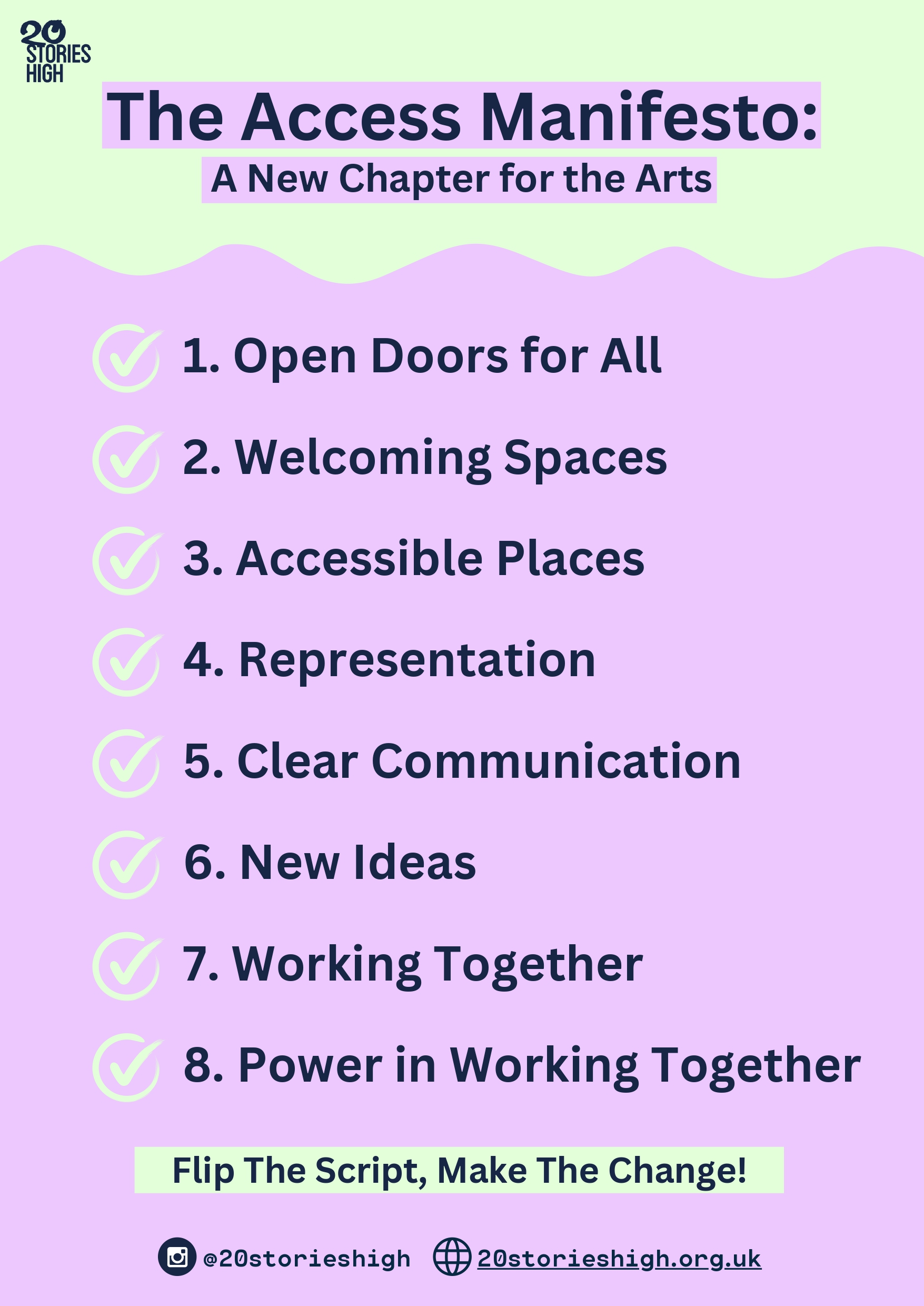
The response? The Access Manifesto — a beacon of change, developed by those directly impacted and designed to inspire and guide the arts sector towards a more inclusive future. They invite you to join them in embracing this new chapter for the arts. Together, we can create a world where every young person, regardless of their abilities, can enjoy and participate in the arts.
“I believe that the Access Manifesto is the first big step to great change… now I just hope that the Arts really listen and apply all that everyone has said.” Ayzah Ahmed, Co-Author of the Manifesto
The Access Manifesto maps out an 8 point plan that can be embraced by all organisations and institutions – simple changes to things like layout, staff training, recruitment, and most importantly, an open and empathetic attitude.
An estimated 16 million people in the UK have a disability:
– An estimated 2 million people are living with sight loss
– Approximately 11 million people are Deaf or have hearing loss
– Around 1.5 million people have a learning disability
– 6.8 million people live with a mobility-related impairment.
This represents 24% of the total population. That’s 1 in 4 people…
While 24% of working-age individuals are disabled, only 7% of people working in the arts are disabled. Disabled employees in the arts are 20% less likely to advance to senior roles compared to their non-disabled counterparts, according to Arts Council England.
Whether knowingly or not, the Arts Sector continues to exclude disabled people — both as audiences and as artists.
The Access Manifesto is aimed at deepening our understanding of the lived experiences of disabled individuals and to recognise the critical importance of accessibility for everyone. Read more Here
Since the launch of The Access Manifesto in late 2024, Maisy Gordon and the team have worked with arts organisations across the country to release multiple guides and resources to support the initiative. These were aimed at spreading more awareness around disability, access and how to practically use The Access Manifesto as a tool.
In a short time, there has been some notable successes. An incredible 26 organisations have already responded and pledged to adopt the Access Manifesto, including the Tate organisation and their galleries in Liverpool and London. Merseyside’s Culture Network have embraced the call and a large number of its members have vowed to begin working towards positive change.
“The Access Manifesto has given us a tangible framework to keep improving, and we’re committed to making the Royal Court a genuinely inclusive space for everyone.” Abigail Middleton, Royal Court Liverpool The message has also begun making inroads nationally, with London’s Almeida Theatre, Travelling Light Theatre Company, The Egg Theatre and Dibby Theatre beginning to embed the Manifesto’s actions into their ongoing development.
“We were able to use the Access Manifesto as a core resource to unlock key concepts and empower even early career producers to be agents for change in the spaces they work in… It’s a fantastic teaching resource, the scalability works for a range of purposes, and inspires hope in an area that a lot of artists feel overwhelmed by.” Alice Eve, Almeida Theatre London
But there’s still much work to do, particularly when the lack of accessibility directly impacts disabled audiences and creatives from accessing work and entertainment. Only 35-50% of theatres in the UK can be considered fully accessible and a meagre 25% of theatres regularly offer captioned or audio-described performances.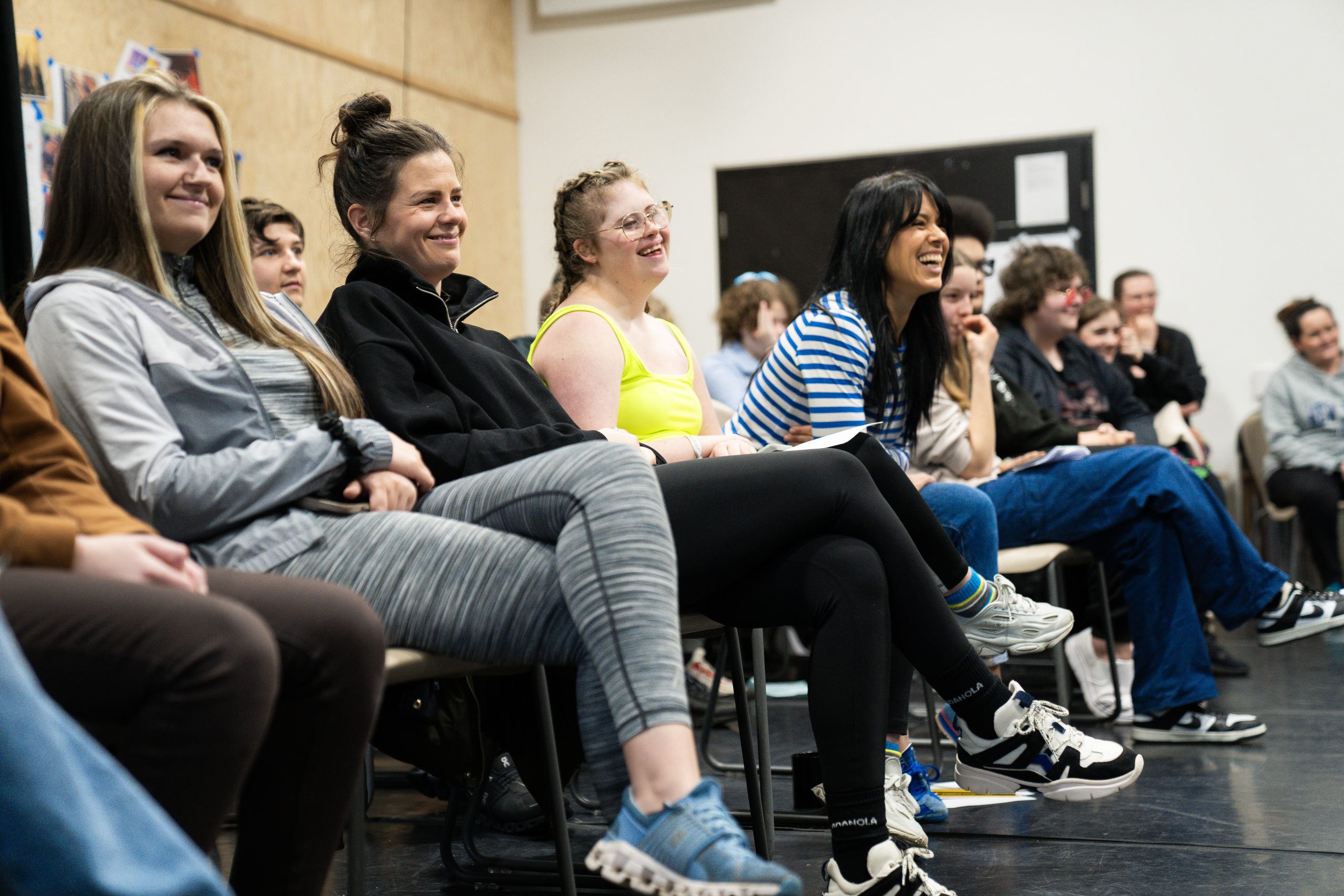 Now that The Access Manifesto has been fully launched, 20 Stories High are looking to partner with other organisations to delve deeper into what can be done to galvanise action. A Space for Us has already begun being developed with Tip Tray Theatre, a disabled-led arts organisation based in Knowsley and founded by Maisy Gordon. This initiative is rooted in the belief that everyone deserves equal access to creative spaces and zooms in on two prominent Manifesto points: ‘Open Doors For All’ and ‘Welcoming Spaces.’ It aims to explore and transform how cultural venues welcome and include disabled audiences, artists and staff.
As a grassroots organisation led by disabled and neurodiverse artists, Tip Tray Theatre brings lived experience to the forefront. Their team and community reflect a broad spectrum of access needs, many of which are still overlooked or underserved in mainstream arts settings. A Space for Us is a direct response to the exclusion and marginalisation often faced by disabled individuals in cultural spaces, and a push for a more accessible and welcoming arts sector.
For updates on the progress of this proposed new project, please follow Tip Tray Theatre.
“This means so much to me, and millions of others in the disabled community. We are so ready for change and I believe this manifesto will do just that.” Maisy Gordon, Co-Author of the Manifesto
The Access Manifesto: A new chapter for the arts is available as a film, with additional digital downloadable documents of the manifesto. Full resources can be found on 20 Stories High and Graeae’s websites and on the links below.
We are calling to all arts leaders and decision makers to engage, share and together make the changes needed!
Leave a comment