


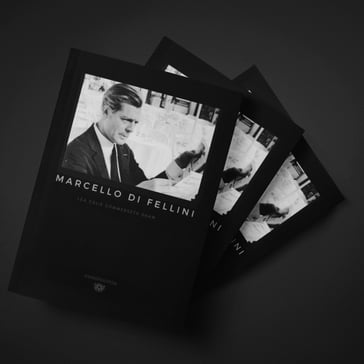
Marcello Di Fellini
amfitheatron.com
By Lea Celik Sommerseth Shaw
Marcello Mastroianni: The Soul of Italian Cinema
By Lea Celik Sommerseth Shaw
In the golden age of Italian cinema, amid the grand visions of auteurs and the shifting tides of post-war Europe, one man stood at the center—not by design, but by destiny. Marcello Mastroianni, with his dark eyes, unassuming grace, and deeply human presence, would come to define a new kind of leading man: flawed, thoughtful, irresistibly real.
Born in 1924 in Fontana Liri, a modest town in central Italy, Mastroianni’s early years were shaped by the hardships and uncertainties of a country
emerging from the wreckage of war. Unlike many of his contemporaries, his path into cinema was not sparked by a youthful obsession with acting or storytelling. His original ambition was to become an architect—a career grounded in structure and logic, far from the spontaneity of stage and screen.
But fate had other plans. During his time in Rome, where the cultural pulse of a rebounding nation was quickening, Mastroianni found himself drawn into the world of performance. It wasn’t a dramatic decision or a lifelong dream fulfilled, but rather a quiet shift, a chance opportunity that evolved into a
life-defining journey. His entry into acting was almost accidental—he was discovered during a theater rehearsal, a role offered not for fame, but for the way he simply carried himself.
What followed was a slow, deliberate ascent. He took smaller parts at first, steadily learning his craft, studying the rhythm of dialogue, the weight of silence, and the delicate balance between self and character. What set Mastroianni apart wasn’t theatrical flair or physical bravado—it was a remarkable emotional intelligence, the ability to inhabit a role without overpowering it.
His breakthrough came when he crossed paths with another titan of cinema: Federico Fellini. The partnership between the two was electric, not in a sensational way, but in how seamlessly their talents aligned. Fellini, known for his surreal, symbolic storytelling, found in Mastroianni a vessel for his dreams—an actor capable of embodying contradiction: the man torn between indulgence and despair, ego and vulnerability, the sacred and the absurd.
In “La Dolce Vita” (1960), Mastroianni stepped into the role of Marcello Rubini, a jaded journalist drifting through Rome’s glittering nightlife. With this performance, he didn’t just act—he reflected an entire generation’s yearning and disillusionment. The image of Mastroianni standing in the Trevi Fountain beside Anita Ekberg became immortal, not because it was glamorous, but because it was hauntingly true.
Three years later, in “8½”, Mastroianni again became Fellini’s mirror. As Guido Anselmi, a film director facing creative paralysis, he brought sensitivity and complexity to a character that might otherwise have been consumed by
self-indulgence. The performance was a masterclass in introspection, delivered with effortless poise.
Mastroianni’s brilliance lay in his duality. He was simultaneously present and elusive, confident and unsure, romantic yet grounded. He never forced a performance. Instead, he let it breathe—allowing space for ambiguity, doubt,
and tenderness. His portrayals were never simply roles; they were conversations with the audience, invitations to feel rather than just watch.
Unlike Fellini, who shaped every frame with meticulous care, Mastroianni approached his art with humility and instinct. He never claimed to be a great actor. He often joked about his fame, shrugging off the “Latin Lover” label with characteristic irony. But this modesty was his strength. It allowed him to slip into roles without ego, to serve the story rather than command it.
Throughout his career, he worked with some of the most influential directors in European cinema—Antonioni, Visconti, Scola—yet his performances never felt rehearsed or ornamental. Whether in political dramas, romantic comedies, or deeply personal stories, he carried a quiet dignity that made every role feel lived-in and true.
And while his screen presence was magnetic, his private life remained relatively subdued. He cherished his privacy, preferring a low-key existence even as international fame swirled around him. His long-term relationship with Catherine Deneuve and his role as a father never became tabloid fodder; instead, they were just parts of the full, nuanced human being he always was.
Marcello Mastroianni passed away in 1996, but his spirit lives on in every actor who values truth over performance, subtlety over spectacle. His career is a reminder that great cinema doesn’t always roar—it often whispers. It is not always constructed, but discovered.
In the end, Mastroianni didn’t chase the spotlight—it found him, and in its glow, he never lost his shadow. He remains a timeless figure, not because he dazzled, but because he made us feel something profoundly real.
About the Author

Lea Celik Sommerseth Shaw
Lea Celik Sommerseth Shaw
Multidisciplinary Artist | Writer | Cultural Entrepreneur | Founder of Biblioteca Babilonia, Amfitheatron and other projects and ventures for LCSS INC
Lea Celik Sommerseth Shaw is Hague based Multidisciplinary artist, author, and cultural curator with a background in visual arts, independent publishing, and international advocacy. She is the founder of Biblioteca Babilonia, Amfitheatron and Cargo Culture, creative platforms dedicated to philosophical exploration, and multilingual projecgts.
Her work blends political consciousness with poetic expression, often drawing inspiration from cinematic heritage, theology, and human rights. As the author of
Marcello Di Fellini, she offers a deeply personal and evocative reflection on the cultural legacy of Italian cinema, connecting the worlds of Marcello Mastroianni and Federico Fellini with contemporary philosophical inquiry.
Lea has also been active in law, policy-making, and grassroots movements, advocating for democratic reform and social justice. Her unique approach bridges art, activism, and philosophy, establishing her as a voice for interdisciplinary cultural innovation.
